Ticket moved to ReadyLinearGitHubVercelSlack
Delivers: A tested pull request with a preview link, ready for review
Software engineering
Feature Builder
Builds each ready ticket into a working feature, with tests, in its own sandbox.

Recursion Managed Agents puts AI agents to work inside the apps your business already uses: Salesforce, Zendesk, NetSuite, Slack, Jira and 100+ more. They start on a schedule, a message or an API call, finish the job, and get better every run.
Recursion Managed Agents runs persistent, long-horizon agents as one fleet across your repos, CI, clouds and data. Hand them a goal, not a script: fix this regression, find the fastest config, keep every dependency current. Sandboxes, credentials, subagents, memory and grading are all handled for you.
100+ integrations across code, CI, incidents, data and docs. Agents take real actions, limited to the tools you allow.
Starts on a failing build, an alert, a merged pull request, a schedule or an API call. Sessions pause on dependencies and pick up where they left off.
A coordinator plans the work and spawns specialists in parallel. Big jobs get more agents, not longer prompts.
A separate grader checks each session against your rubric and sends it back until every criterion passes. Every finished session feeds the agent’s memory.
A coordinator breaks down each request and sends the right checks to specialist agents with the models and apps they need. The specialists gather the evidence, and the coordinator brings it together into a recommendation.
A separate grader evaluates the result against your rubric, criterion by criterion, using the evidence gathered along the way.
Set the standard, measure every outcome, and manage agent quality at scale.
See every agent at work in one place, from flaky tests and incidents to eval reruns and experiment sweeps. Know what’s done, what’s in progress, and how well each agent is performing.
Get a live view of your operations and the quality of every run.
Red builds, flaky tests, dependency bumps, an eval rerun on every checkpoint, a sweep that needs watching overnight. Most of it comes back on a schedule or lands in a queue, follows the same steps each time, and there’s more of it than your team can get to.
Your engineers use coding assistants all day, and they ship faster for it. But every session starts with someone at the keyboard: someone has to notice the red build, start the work, check the result and push it where it belongs. When they log off, the queue keeps growing.
Its agents start on a failing build, an alert, a new checkpoint or a schedule, run hundreds of sessions in parallel when the queue is long, and hand back pull requests and results. Nobody has to press go.
Each agent has one job, the tools it may use and what starts it: a failing build, an alert, a new checkpoint or a schedule. No one has to open a chat and ask. These are a few of the jobs engineering and research teams run on it; any work that keeps coming back can be one.
Connect 100+ tools across code, CI, incidents, data and docs, then choose exactly which tools each agent may call: read only, changes data, or destructive. Credentials stay in a vault, and every tool call is recorded in the session transcript.
Credentials stay in the vault. The agent sees only the tools you turn on, and every call lands in the session transcript.
Slack, GitHub, Jira, Confluence, Google Cloud Logging, Loom and LaunchDarkly are built into Recursion Managed Agents. Start an agent from a Slack message and get the result back where your team works.
Datadog, PagerDuty, Sentry, Snowflake, Databricks and the rest of the catalog. Connect once, then turn tools on per agent.
Point an agent at any MCP server, internal or third party, and set the same per-tool permissions.
Some work only happens in a browser: vendor portals behind a login, sites with no API, forms that have to be filled in by hand. With computer use, the agent gets its own browser to sign in, search, fill in forms and download files. Put it on a schedule and it does the rounds every week on its own. Every click is saved as a screenshot you can replay.
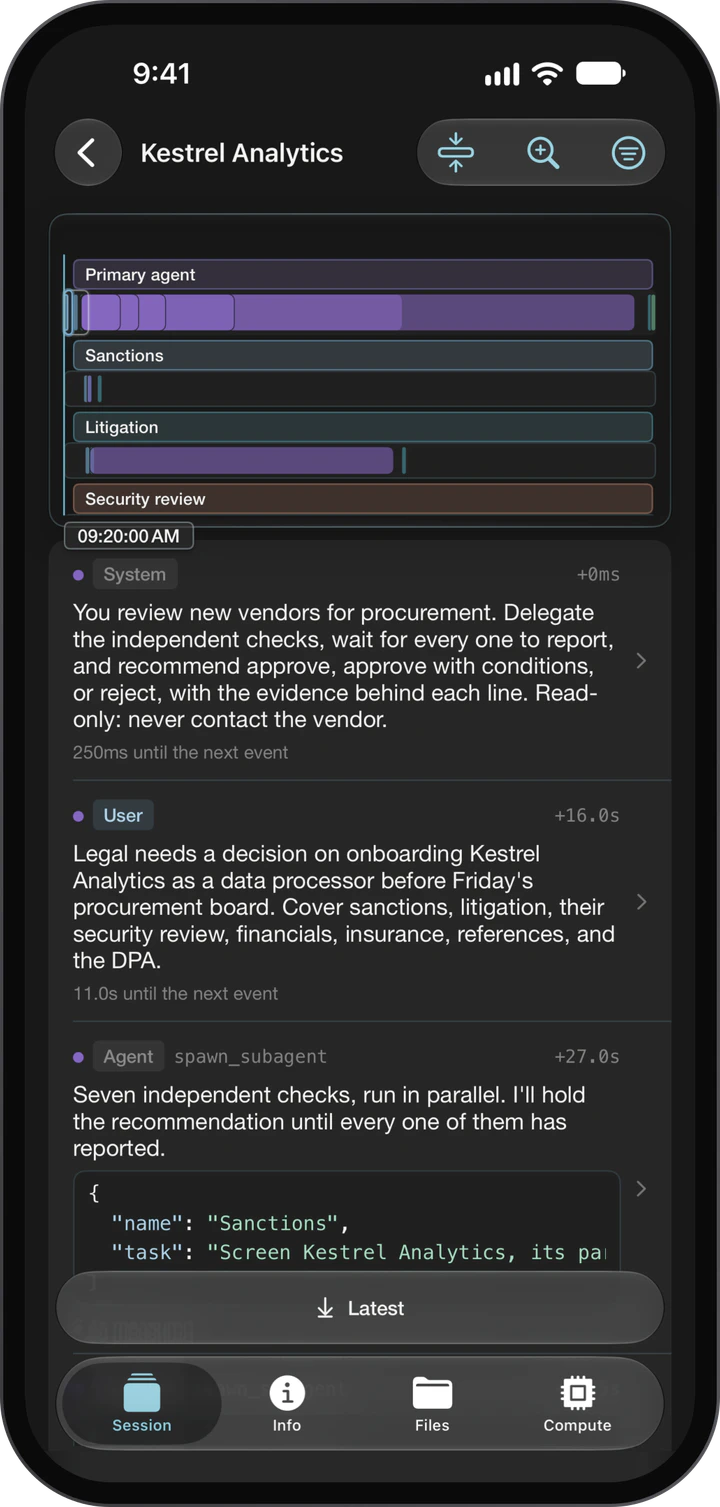
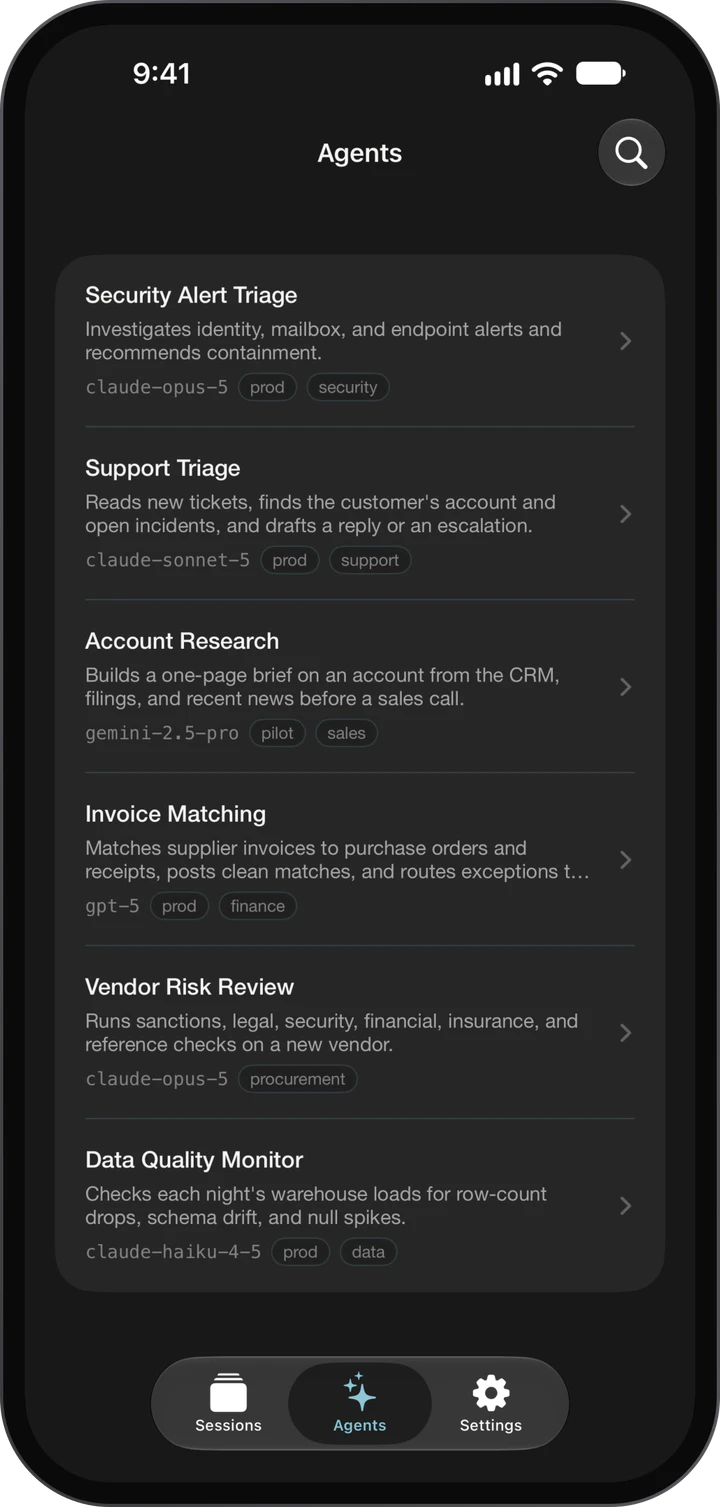
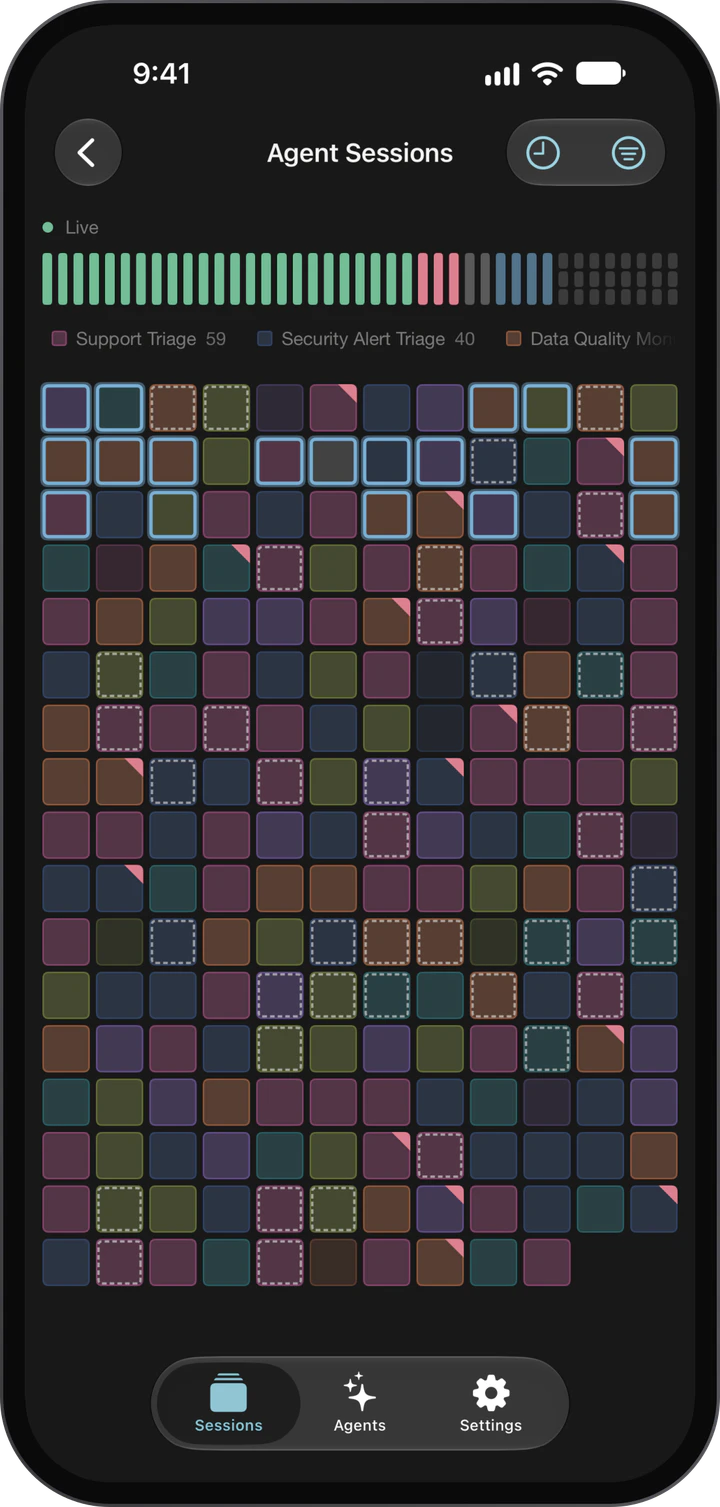
Your agents keep working after you log off. Check on them from your iPhone or iPad: see every session on one board, follow a run as it happens, and open the reports and files they made. Widgets on your Home Screen and Lock Screen show what’s running at a glance.
Memory makes each run better. Fine-tuning makes the model itself better. When a job runs at volume, Recursion Managed Agents turns its graded runs into environments and evals, trains a specialist with reinforcement learning, and adds it to your fleet when it beats the model the agent runs today.
Every session scored against your rubric
Real tickets become repeatable scenarios
Held-out checks on every criterion
Rewarded for passing your rubric
Promoted when it beats the model it replaces
On the job it was trained for, the specialist resolves more tickets than frontier models, invents less and answers faster, at a fraction of the cost.
Support Triage after fine-tuning: more tickets resolved, fewer hallucinations, faster responses and lower inference cost than frontier models
Resolution rate
Support specialist v3
84%GPT-5.5
76%Claude Opus 4.8
73%Reduction in hallucinations
Support specialist v3
72%GPT-5.5
46%Claude Opus 4.8
41%Cost per 1,000 support tickets
Support specialist v3
$32GPT-5.5
$158Claude Opus 4.8
$176Time to first token
Support specialist v3
0.42sGPT-5.5
1.10sClaude Opus 4.8
1.28sAgent platforms from the AI labs run only their own models. Recursion Managed Agents runs any model on any job, including your own checkpoints, works across the tools your engineers already use, and turns every graded run into a better specialist.
Other managed agents: the leading AI labs' agent platforms, based on their public documentation as of September 2026.
Every session runs in an isolated sandbox with only the tools and credentials you grant it. Recursion Managed Agents attaches each credential to the approved call, so the model never sees it, and keeps it to the hosts you allow. Every model turn and tool call lands in an audit-ready transcript, backed by Labelbox's enterprise security and compliance program.
Start with the job your engineers repeat every week: a red build, a flaky suite, an eval rerun. Connect the repos and tools it touches, describe what done looks like and pick what starts it. From then on, it gets done before anyone thinks to ask.